
Tank Gallons Calculator
Choose your tank shape and enter its dimensions to get the total capacity in US gallons, imperial gallons and litres. For horizontal cylindrical tanks you can also enter the liquid depth to see how many gallons are in the tank right now.
- Free to use
- No sign-up
- Runs in your browser
Calculate tank gallons
Tank Dipstick Chart Workbook
Generate a dipstick-to-gallons chart for any horizontal, vertical or rectangular tank, plus a fuel and water level log.
- Dipstick chart generator (XLSX, PDF)
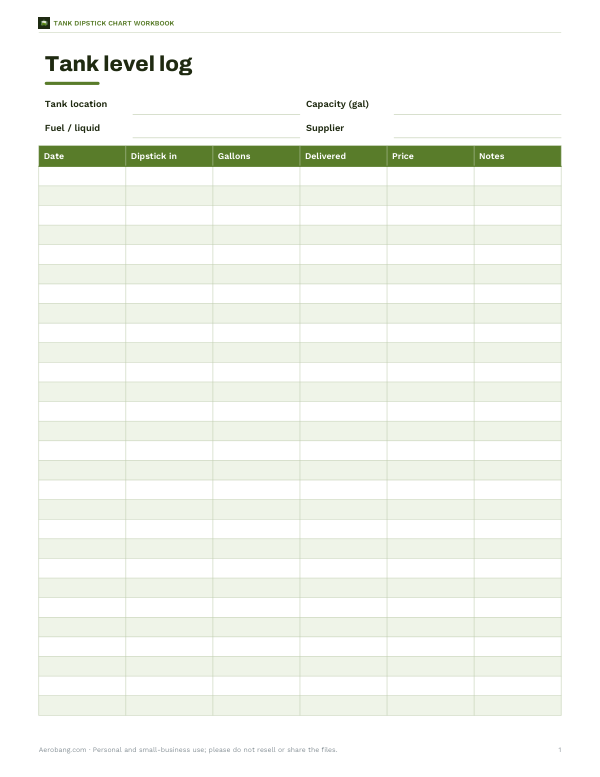
- Level & delivery log (PDF, DOCX)
Formats: XLSX, PDF, DOCX. Instant download after payment (link valid 72 hours, up to 5 downloads). AI-assisted: the templates were drafted with AI help and reviewed and laid out before publishing.
$5.00 USD, one-time
- Instant download
- 7-day refund
- Secure checkout by Stripe
7-day money-back guarantee. Full refund within 7 days of purchase, even after you download.
Full refund within 7 days — see the refund policy and license.
Free printables
Single sheets you can print right now, no sign-up. The full pack adds every sheet in one download plus the editable files.
Tank volume formulas
Every tank calculation multiplies the cross-sectional area of the tank by its length. The calculator converts all dimensions to centimetres, computes the volume in cubic centimetres, and converts: 1,000 cm³ is one litre, one US gallon is 3.785 litres, and one imperial gallon is 4.546 litres.
| Tank shape | Volume formula |
|---|---|
| Rectangular | length × width × height |
| Vertical cylinder | π × radius² × height |
| Horizontal cylinder | π × radius² × length |
| Capsule | π × radius² × (length − diameter) + 4/3 × π × radius³ |
| Elliptical (oval) horizontal | π × (width ÷ 2) × (height ÷ 2) × length |
In US customary units, a shortcut for rectangular tanks is: cubic inches ÷ 231 = US gallons, and cubic feet × 7.48 = US gallons.
Partially filled horizontal tanks
A horizontal cylinder is the tricky case, because the liquid surface is a flat chord across a circle. Doubling the depth does not double the volume: near the bottom and top the tank is narrow, in the middle it is widest. The calculator uses the circular-segment formula: segment area = r² × arccos((r − h) ÷ r) − (r − h) × √(2rh − h²), where r is the radius and h is the liquid depth, and multiplies by the length. For a capsule tank it adds the matching portion of the spherical ends. Measure depth with a clean dipstick at the tank's centre, straight down, and keep the tank level for an accurate reading.
Worked example
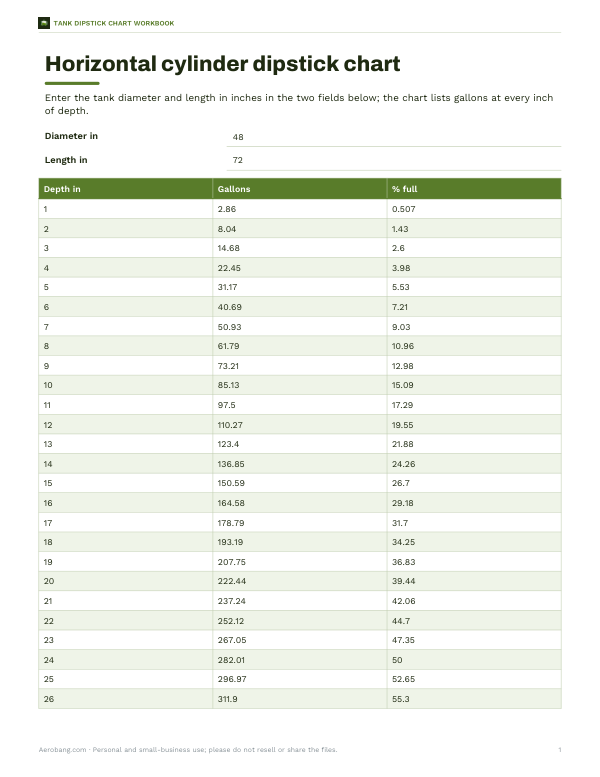
A horizontal fuel tank is 72 inches long with a 48-inch diameter. Its full volume is π × 24² × 72 = 130,288 cubic inches, which is 564 US gallons (2,135 litres). With 20 inches of fuel measured on a dipstick, the circular-segment area is about 689 square inches, giving 689 × 72 ≈ 49,600 cubic inches — about 215 gallons, or 38% of capacity, even though the depth is 42% of the diameter. The tank is narrower at the bottom than in the middle, so volume lags behind depth until the halfway mark.
Common uses
- Heating oil and diesel tanks — estimate fuel on hand before ordering a delivery.
- Water storage and rain tanks — size a tank for the supply you need or check how many days of water remain.
- Aquariums and ponds — rectangular volume gives nominal gallons before rocks and substrate displace water.
- Agricultural sprayers and nurse tanks — mix chemicals at the correct rate per gallon.
- Hot water heaters and pressure tanks — check rated capacity.
- Truck and trailer tanks — estimate payload weight (water weighs about 8.34 lb per US gallon).
Nominal versus usable capacity
The volume the calculator gives is the geometric capacity of the interior. Manufacturers often state a slightly different nominal capacity, and the usable volume is lower still: outlets sit above the bottom, sludge collects at the base of fuel tanks, and tanks are not filled to the very top to allow for expansion. Heating oil tanks, for instance, are commonly filled to around 90% of capacity. Use the interior dimensions if you can measure them; outside dimensions include wall thickness and overstate the volume slightly.
Measuring tips
- Measure inside dimensions where possible; for steel tanks, subtract twice the wall thickness from outside measurements.
- For cylinders, measure the circumference with a tape and divide by π (3.1416) to get an accurate diameter.
- For tanks with dished or rounded ends that are not full hemispheres, the capsule result overestimates slightly; the horizontal cylinder result on the straight length underestimates. The truth lies between.
- Record measurements with units; mixing inches and feet is the most common error.
Weight of liquid in a tank
Knowing gallons lets you estimate weight — important for stands, trailers and floors. Water weighs about 8.34 pounds per US gallon (1 kg per litre); diesel about 7.1 pounds per gallon; gasoline about 6.1; heating oil about 7.2. A full 564-gallon water tank therefore weighs roughly 4,700 pounds plus the tank itself. Make sure the support and any vehicle are rated for the full load.
Making a dipstick chart
Because depth and volume are not proportional in horizontal and oval tanks, many owners keep a printed chart that converts dipstick readings to gallons. Enter the tank dimensions once, then change the liquid depth in one-inch steps and note the gallons for each reading; the paid workbook builds the whole chart automatically. Keep the chart with the dipstick, mark the tank's serial number or location on it, and remeasure if the tank is replaced or moved to a site where it no longer sits level.
Frequently asked questions
How many gallons are in a cubic foot?
About 7.48 US gallons.
How do I calculate gallons in a rectangular tank?
Multiply length × width × height in inches and divide by 231.
Why is my half-depth tank not half full?
It is exactly half full at half depth for a horizontal cylinder, but at other depths the curved sides mean volume and depth are not proportional.
How much does a gallon of water weigh?
About 8.34 pounds, or 3.785 kilograms.
What is the difference between US and imperial gallons?
An imperial gallon is about 20% larger: 4.546 litres versus 3.785 litres.
Can I use outside dimensions?
Yes for an estimate, but subtract wall thickness for accuracy, especially on thick plastic or concrete tanks.
How do I measure the liquid depth accurately?
Use a clean wooden or marked dipstick lowered vertically through the fill opening at the middle of the tank, and read the wet line. Tank gauges on the lid can drift, so check them against a dipstick occasionally.
What about tanks with flat ends and rounded corners?
Treat them as rectangular for a first estimate and subtract a little for the rounded corners, or measure the cross-section as an oval.
How many litres is 500 gallons?
About 1,893 litres in US gallons, or 2,273 litres if the figure is in imperial gallons.